What is a Head Nod®
Head Nod® posture restores vertebral body loading and unloads the facet joints of the upper cervical spine. It pulls you out of forward head posture. By doing so, it maximizes the space for the nerves exiting the brain as well as blood supply to the brain. To gain a better understanding of the importance of Head Nod® posture it is important to understand is opposing posture, forward head posture.
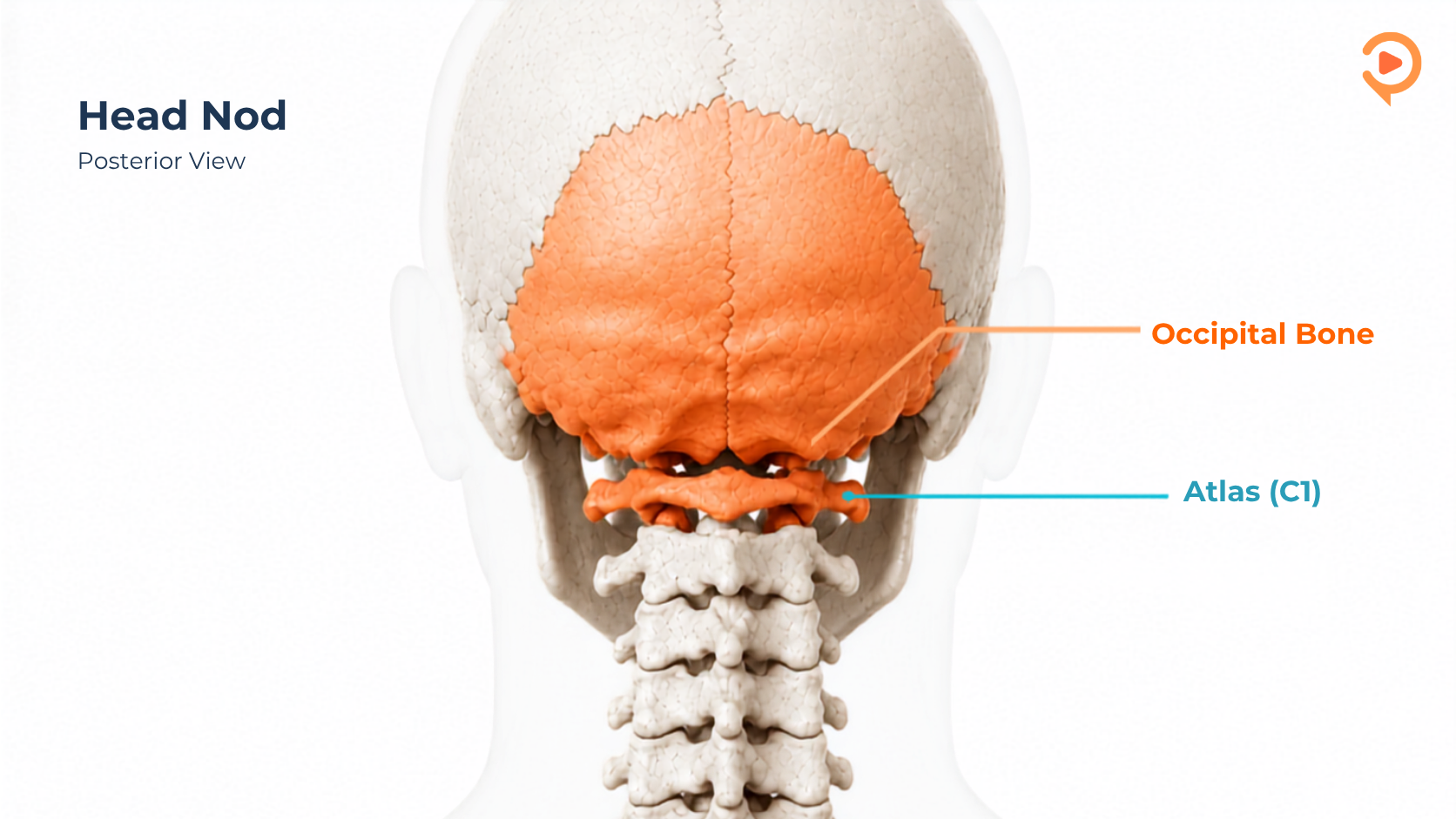
A Head Nod® is when your skull rocks back (posteriorly) on C1 into its neutral position. A Head Nod is not a “chin tuck”, it is a subtle rocking of the skull posteriorly on C1 from a stacked upper back just enough to allow you to look straight ahead. You cannot get into a Head Nod until you stack your upper back via a Chest Lift®. A Head Nod® is one of the 4 Principles of Neutral Spine Alignment within the Healthy Posture System™.
The muscles that rock the skull back into its neutral position on C1 are the sub-occipital flexors. You know you are in a head nod when you feel are looking straight ahead after stacking your upper back into chest lift posture. You will also feel a stretch at the base of the skull when your skull is in its neutral position on C1.
Why is Head Nod® Important?
Head Nod® posture restores vertebral body loading and unloads the facet joints of the upper cervical spine. It pulls you out of forward head posture. By doing so, it maximizes the space for the nerves exiting the brain as well as blood supply to the brain. To gain a better understanding of the importance of Head Nod® posture it is important to understand is opposing posture, forward head posture.
Consequences of Forward Head Posture:
.jpg)
Cervical Spine (neck): When you are in forward head posture, only 2 of the 7 vertebrae in the cervical spine are contributing to supporting and mobility; the other 4 are on vacation.
- Forward Head Posture. When the skull sits anteriorly (forward) on C1 a significant amount of compressive forces are placed on the cervical spine. Forward head posture can cause any of the following symptoms.
- Head Tilt Posture. The head can only sit in front of the upper back for so long before forward head posture progresses into head tilt posture. Head tilt posture is when the head tilts to one side, it is usually a result of a vertebral misalignment.
Joint Clearing Technique (Xylophone): We teach the self-correction technique for forward head posture as early as level 2 of the HPS; level 3 for head tilt posture when a client reports symptoms consistent with these misalignment or when a client physically presents with these posture asymmetries.
Common Cervical Spine Joint Misalignments.
- Upper Cervical Spine: Unlike the rest of the spine, there are no interlocking bony facets or protective intervertebral discs between the skull, C1, and C2. The entire joint relies completely on muscles and ligaments for stability. Because C1 balances the heavy weight of the head like a bowling ball on a broomstick, a sudden jarring movement, concussion, or even sleeping in an awkward position can cause it to rotate or slide slightly out of place.
- Lower Cervical Rotation The C5-C6 level is the single most frequent site for chronic misalignment, closely followed by C6-C7. These vertebrae sit at the bottom of the neck's curve and bear the brunt of the weight of the head. In daily life, prolonged slouching or looking down at screens ("tech neck") pulls this region out of its natural curvature. In high-impact traumatic injuries—such as whiplash from motor vehicle accidents—more than 70% of lower neck dislocations and subluxations cluster squarely at these two levels.
Joint Clearing Technique (Xylophone): We teach the self-correction technique for misalignments in the cervical spine at level 5 of the HPS when a client reports symptoms consistent with this misalignment or when a client is presenting with functional mobility deficits consistent with these misalignments. There are 8 progressive levels of the cervical counter rotation joint clearing series. within the HPS. These joint clearing techniques require online coaching.
Common Symptoms: headaches, muscle strain, radicular symptoms down the arm, dizziness, brain fog and altered cardiovascular performance.
Potential Diagnosis’s: cervical sprain/strain, degenerative disc disease, spinal osteoarthritis, cervical radiculopathy, spinal stenosis, spondylolisthesis, whiplash, CCI, cervical instability, sub-occipital neuralgia, herniated or building disc.
Shoulders: When the upper back is collapsed, the shoulder blades (scapulae) are forced off their neutral position on the rib cage. This results in rounded shoulder posture which places the weight of the shoulder blades onto the muscles that turn the head now that they are no longer resting against the rib cage. This puts you at risk for headaches, thoracic outlet syndrome and muscle strain-oriented pain in in the upper back.
The shoulder functions optimally when the scapulae are in their neutral position on the rib cage at a very precise angle (35°-40▪ anteriorly). Collapsed upper back posture causes your scapulae to migrate forward and off their neutral position. The shoulder blades house the socket of the shoulder (glenoid fossa) and the anterior displacement as a result of collapsed upper back posture put stress on the shoulder joint. Putting you at risk for shoulder impingement, rotator cuff tendonitis and biceps tendonitis.
Summary:
Your posture is a key aspect to longer term injury prevention and healthy aging. A complete posture restoration program must pull your out of collapsed upper back and forward head posture and condition you to function from that posture throughout a majority of your day. Any rehabilitation program for neck pain or shoulder pain that does not restore access to neutral spine alignment before prescribing strengthening exercises may reinforce the faulty loading patterns that are causing the joint misalignments that are causing your pain.
The Healthy Posture System™ is a system of neutral based functional fitness exercises that condition you to apply the 4 principles of neutral spine alignment in every daily activity, exercise, sport and recreational activity to reduce your risk of injury. Proprietary joint clearing techniques are built into each workout to ensure you strengthen the right muscles every workout for long-term injury prevention.
The Healthy Posture System™ is a system of neutral based functional fitness exercises that condition you to apply the 4 principles of neutral spine alignment in every daily activity, exercise, sport and recreational activity to reduce your risk of injury. Proprietary joint clearing techniques are built into each workout to ensure you strengthen the right muscles every workout for long-term injury prevention.
“You cannot unload the neck and low back until you stack your upper back.”
Video Resources
The Science of a Head Nod° ǀ Why Head Nod° Posture is Such a Problem